Thursday, 6 October 2016

The Deer Hunter - Classic Movie Review

Image result for deer hunter
The Deer Hunter, Cimino's take on the Vietnam movie contrasts the comfort of every day life in America to the flip side as a Prisoner of War in Vietnam. The near three-hour narrative tracing the classic human parabola from wedding bliss to funeral blues, and the ultimate test of friendship.

We open in the hellish heat and sulphurous fumes of the Pennsylvania steel mills, where friends and co-workers Michael (Robert De Niro), Nick (Christopher Walken), Stan (John Cazale), Steven (John Savage) and Axel (Chuck Aspergen) endure inhuman conditions for pay, night after night.

These are tough men, we are told. The weekly reward for the steelworkers is escape into the cool mountains, and Michael in particular is soon scampering across snow-capped peaks with a gazelle's grace. But, lest we forget that a ticket to heaven comes at a prix fixè, Michael tracks and kills a beautiful stag, as if nature itself must pay his tithe.

It's a film of striking and often startling contrasts, and Cimino doesn't once flinch from an unpromising gear change. Indeed, The Deer Hunter is distinguished by quite audacious transitions from high to low, light to dark.

At one point, Michael, abandoned in his motel room at night, suddenly appears at the other side of the frame, still shrouded in darkness; only when he steps forward into the light do we realise that it is now daytime and he is outside, standing in the shade, hiding from his friends.

And, famously, there is the sudden jolt into Vietnam. The hunting buddies, exhausted and exhilarated from a successful trip, come to rest around a piano played by George Dzunda's lovable bar owner; dimly, the rhythm of what sound like rotor blades underscore the pretty melody. Without warning we are in another world, helicopters rain napalm down on a green forest.

If, as Dante maintained, hell is composed of seven levels, we have just slipped down several stages at once.

At a time when patience was a given rather than a virtue, '70s audiences were happy to endure the inevitable longueurs - a 40-minute wedding production number that fails to forward the plot - because word-of-mouth had assured them that all hell would soon break loose.

And for cinema goers who had yet to be fed money shots and special effects, the notorious Russian Roulette sequence - where Prisoners of War Michael, Nick and Steven must face off against each other for the amusement of their Viet-Cong captors - which takes place early in the second hour, was the equivalent of a must-see, water-cooler moment.

Simply one of the most terrifying scenes in celluloid history, this sequence alone ensured that The Deer Hunter would become perhaps the most unlikely blockbuster of all time. When the film went on to dominate the 1978 Oscars - taking five awards including Best Film and Best Director - Cimino was heralded as the poster-child for the brave new world of American cinema. A man, it was supposed, who could do no wrong.

On his return from Vietnam, Michael's failure to reconnect with friends whom he once openly patronized is lent a genuinely tragic dimension. There is no way Michael could explain what he has seen, what he has lived through, even if he wanted to.

And in a movie that is practically spoilt for stand-out performances, Meryl Streep's luminous debut, John Cazale's last screen appearance, Christopher Walken's Oscar-winning breakthrough, De Niro is always central, manfully shouldering the film just as Michael carries the crippled Steven to safety. His work with Scorsese is more expansive, more celebrated, but Michael is De Niro's signature performance: the enigmatic, stoic, thoroughly Nietzschean hero who has not only appeared in various forms (see Heat's Neil McCauley) throughout his career, but one that we mere mortals can easily imagine is a close relation of the great man himself.

The Deer Hunter is a grueling film, an upsetting experience, as much an endurance test for the audience as it was for cast and crew fighting a private war on location in Thailand. And yet, from the justly ubiquitous theme music to Vilmos Zsigmondís rich and lyrical cinematography, The Deer Hunter is a film of enormous, if mostly melancholy, beauty.

As such, it contains a raw power to move, and in some cases, bait, audiences to extremes of emotion almost unparalleled in cinema. At the time this was an astonishingly ambitious attempt to dress a wound in the American psyche that was still fresh and weeping; 25 years on,The Deer Hunter deserves to be reclaimed as one of the most powerful humanist tracts ever committed to celluloid.

A simultaneously touching and harrowing experience that puts the audience directly in the shoes of one man's experience of Vietnam.

Monday, 3 October 2016

Hunt for the Wilderpeople - Movie Review

Director Taika Waititi has had a stranger career trajectory than most. That he’s the man who’s being trusted to make Thor: Ragnarok by Marvel Studios implies a certain kind of director, but his previous film — 2014’s horror-mockumentary What We Do In The Shadows — suggests someone entirely different. And if you were surprised to see Marvel hand him such a high-profile gig, Hunt For The Wilderpeople is hardly going to make you feel differently.

But that’s by no means a bad thing. Coming on like a low-budget, live-action Up directed by a Wes Anderson who doesn’t mind getting muddy, this adaptation of Barry Crump’s 1986 novel Wild Pork And Watercress is the ideal showcase for Waititi’s exuberant sense of humour and flair for inventive absurdity. Neill is the nominal star, playing grieving ex-convict Hec Faulkner, though it’s 13-year-old Dennison who gets all the best lines as the juvenile delinquent on a bizarre outback adventure. At one point, the pair have to cower beneath an outcrop as their pursuers stalk overhead. Ricky frantically gestures at his foster dad-turned-wilderness survival mentor, but Hec can’t work out what vital information he’s trying to convey. The danger passes; Hec wants to know what the problem was. “I was trying to tell you it was like The Lord Of The Rings!” exclaims Ricky.

Divided into ten titled chapters, which feature the world’s worst eulogy (courtesy of a fantastic Waititi cameo), seemingly gigantic wild boar and a climactic car chase that references Thelma & Louise,Wilderpeople presents a comically heightened world. This may nudge a few of its inhabitants into caricature territory, but it’s mitigated by a strong sense of warmth, sweetness and humanity pervading the entire film.

Once again, Dennison is the hero here. As Ricky, he can be obtuse, offensive and obsessed with being “gangster”. But moments later he’ll remind us he’s an abandoned child in need of emotional security — such as when he develops a dependence on hot water bottles or envisions a girl he meets in a faux-erotic ’80s Flake ad.

And with Neill he forms a fractious double act that manages to develop a convincing emotional connection between spiky whippersnapper and cantankerous old-timer without miring itself in ‘heartwarming’ cliché. There’s a refreshing lack of sentimentality to Wilderpeople and Waititi allows the drama to hit hard where it needs to, so it roots itself far deeper than the whimsical trimmings might suggest. Some scenes will get you swearing there’s just something in your eye; others will make you honk like a goose on nitrous oxide. You’ll be left with a glow that’ll ensure Wilderpeople a place on your best-of-year list.

Deftly balancing humanity with comedy? Creating nuanced, loveable characters within a style-heightened world? Actually, perhaps Waititi’s Marvel gig isn’t so surprising, after all.

A bit Up, a bit Moonrise Kingdom, a bit Midnight Run, even… Taika Waititi’s latest is an oddball treat of a mismatched-buddy pursuit move.

Full Metal Jacket - Classic Film Review


Image result for full metal jacket cinematography

The totality of war, from the loss of self to ultimately the loss of life, has never been as thoroughly examined as in Kubrick’s much misunderstood Full Metal Jacket. Other films, of course, exist that portray the brutality (Platoon), the senselessness (Apocalypse Now) or even the joy (Patton) that is to be found in slaughtering your fellow man. But no film takes us through “the shit” from beginning to the sick, sick end like Jacket does. Our guide along the path to hell is Modine’s Joker; a young but scrappy Marine recruit with his eyes wide open. To me, one of the greatest joys in cinema is, for lack of a better term,character development. Watching a person transform from something to something else due to circumstance is, well, rewarding. Joseph Campbell termed it as “the hero’s journey.” Shorthand, think of either Luke or Han in Star Wars; they start out thinking and believing one ideal, and exit the narrative knowing and following another. For a real lesson on this journey, check out all three lead characters in LA Confidential (review forthcoming — I promise). Joker starts his journey as an arrogant but righteous little shit. In the middle of Gunnery Sgt. Hartman’s (the amazing R. Lee Ermey) initial epic tirade, Joker will not abide the playful yet ultimately sick racism thrown in his face. Hartman breaks him down with a “gut stomp” that leaves Joker broken, but largely unbowed. By the end of the film, Joker shoots a dying “gook” woman in the face. And how the hell did this happen?

Full Metal Jacket begins with perhaps the most enjoyable forty-five minutes in the history of all film. Sgt. Hartman’s brow-beatings, even after the twenty-fifth viewing, are both colossal and hilarious. Most people I enjoy spending time with can quote them not only at length but verbatim — as they should! Ermey’s comedic timing is impeccable and really, unprecedented. A quick for instance; when Cowboy tells that he is from Texas, Hartman immediately snaps, “Holy dog shit! Texas? … Do you suck dicks?” I mean… fuck — brilliant! And I could go on and on and on because the vicious hilarity never ends (read the script for yourself, or better yet, watch the movie). And I could guffaw with you all night, but the question becomes why does Sgt. Hartman behave in the way that he does? To what purpose? What end? A few minutes before, Hartman answers my question, “If you ladies leave my island, if you survive recruit training, you will be a weapon, you will be a minister of death, praying for war.” Once you have internalized the comedy, you realize that Hartman is in fact offering the recruits a new outlook, a new philosophy if you will. One that must be implemented by utter force and that has an ugly end, but a complete system nonetheless. And, if you can past his brutal methods, you can see that he is quite, well “lovingly” is not the right word, but if these men are not trained, if they are not “born again hard,” they will in fact be in a “world of shit.” Hartman did not create the world of shit; he simply wants to give his beloved marines the best chance possible. Maybe “lovingly” is correct after all?

The turning point for Joker was the “sock party” beating of Leonard. To me it seems as if Kubrick went to great lengths in establishing the father/son dynamic between the two. Recall the “Jesus, you look like shit today, Leonard” scene where Joker is fixing Pyle’s clothing. The lost-dog look on Leonard’s face is a testament to the art of directing. One can almost imagine a dad getting his son dressed for church. And when it comes time to beat Leonard, an act that is against Joker’s very nature, he submits to the Corp and beats and beats and beats. Immediately afterwards, he is forced to cover his ears to hide Pyle’s screams. Even after nearly twenty years of viewing, that scene still chills me. Hartman and his methods have won out; the old Joker is no more. Leonard, of course, goes through the transformation but, see, he’s a non-hacker. Hartman turned him, but not into a Marine. Hartman failed, and in the cold logic of warfare, was ultimately punished for doing so.

I’m being too dry and I apologize — with a film such as this — quite similar toDr. Strangelove — nearly every scene is not only memorable, but apparent. Obvious, even. Full Metal Jacket is near impossible to review — a challenge at any rate. OK, so we got character development, right? Keep reading: Joker becomes half hard after finishing up on Paris Island, but as soon as we get to ‘Nam,” he’s back, sort of, to his old John Wayne, wisecracking self. He is still playing the father-role, though. This time to an empty-headed yet idealistic photographer named Rafterman. Joker is now reporting for Stars & Stripes, a military paper that only runs two types of stories, “Grunts who give half their pay to buy gooks toothbrushes and deodorants–Winning of Hearts and Minds–okay? And combat action that results in a kill–Winning the War.” The echoes of today are unmistakable, which again points to the completeness and universality of Jacket. Joker mouths off to his editor one to many times and he and Rafterman are sent deep into the shit. Of note is a particularly grim scene where en route, they ask a door gunner that is shooting wildly at all types of peasants, how he can kill women and children. “Easy — you just don’t lead ’em so much.” Thus begins a descent into the worst and ugliest examples of the human experience. Comparisons to Apocalypse Now — among others — are obvious and easy. But I argue that Kubrick’s vision is much more twisted. For while Coppola’s tale is wild, boisterous and exotic, Kubrick’s does nothing but cycle between the mundane and death. For the last forty-five minutes of Jacketracism and ignorance are everywhere. More importantly, every other scene has the Marines dealing with dead bodies. Almost immediately the deaths lose their meanings. Hunkered down over a just-deceased soldier, Joker congratulates Cowboy on being named squad leader. And he means it.

It must be noted that this casualness is in fact Hartman’s doing, for its roots are back on Paris Island. Think of Hartman’s near constant marching and the chants he forces them to repeat;

One, two, three, four! United States Marine Corps!
One, two, three, four! I love the Marine Corps!
My Corps!
Your Corps!
Our Corps!
Marine Corps!
I don’t know but I’ve been told!
Eskimo pussy is mighty cold!
Mmm good!
Feels good!
Is good!
Real good!
Tastes good!
Mighty good!
Good for you!
Good for me!

This constant mixing of God and country with the absurd is drilled into the recruits. From Hartman bragging that both Whitman and Oswald learned to shoot as Marines to Joker worriedly telling Cowboy that he doesn’t think Leonard can hack it, pausing for a moment, and then continuing with, “I want to slip my tube-steak into your sister,” clarity of purpose is all but vanquished. All of it is hilarious on the outside, but ultimately a sick, sick survival method and nothing more. Remember when Animal Mother explains that he’s not going to die for “Freedom?”‘ If he’s going to die for a word, that word is “Poon-Tang.” And why the hell not? Since pin-pointable meaning has been entirely stripped from their existence, why not have poon-tang be what you die for? Makes as much sense as anything else. And why not shoot a dying woman in the face and then go marching off through a fiery war zone singing the Mickey Mouse Club theme? Hell, that seems almost sane! As Eight Ball says, “…under fire Animal Mother is one of the finest human beings in the world. He just needs someone to throw hand grenades at him for the rest of his life.” Amen.

Monday, 29 August 2016

Kubo and the Two Strings - Movie Review

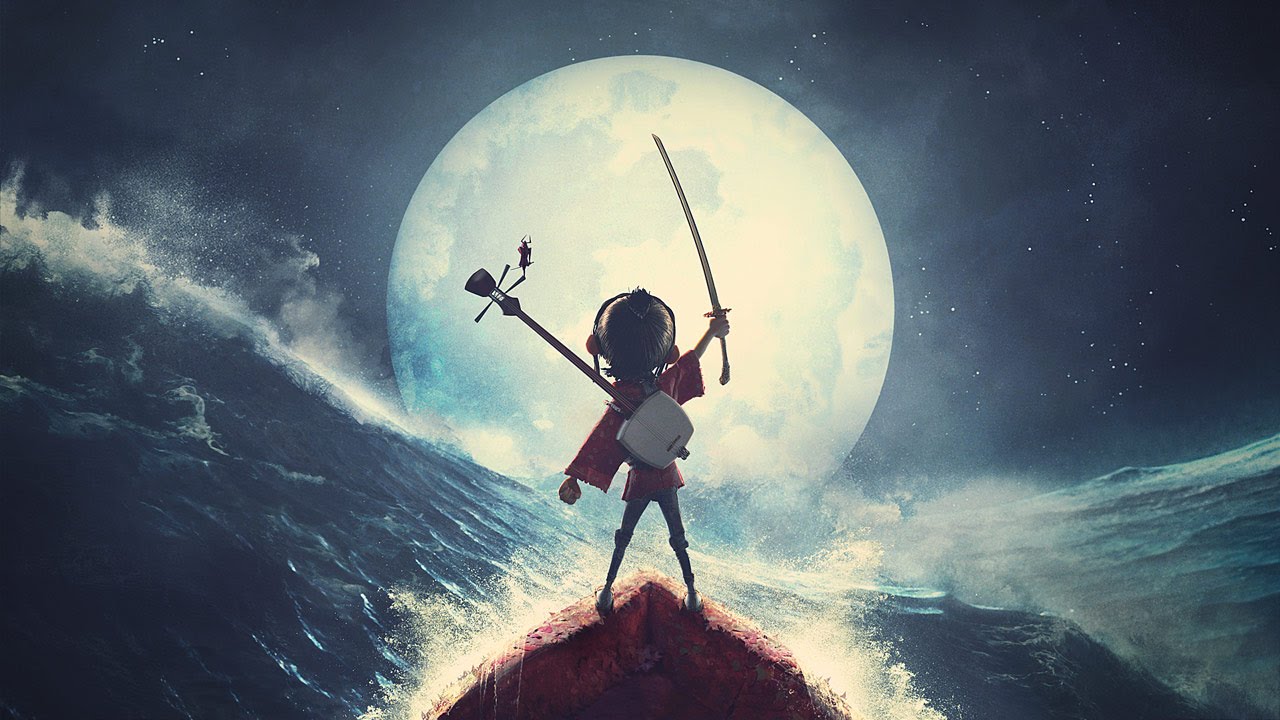
Image result for kubo and the two strings
Kubo and the Two Strings begins with a thrilling, immaculately animated prologue, a tale of legendary heroism that sets a precise tone for the storytelling-obsessed film to follow. Once, a woman steered her boat through a troubled ocean, struggling to protect her newborn child at all costs. With only her magic and her shamisen (a Japanese stringed instrument), she manages to find her way to shore, cutting through the roiling waters like a certain prophet before her. But in Kubo’s world, magic and divinity alike are more complex than they seem. And survival isn’t necessarily a happy ending. Not when your child has lost one of his eyes to the forces of evil, at such a young age.

Laika, the visionary hybrid animators behind Coraline, Paranorman, and The Boxtrolls, have managed to craft a film that expands on the virtues of their predecessors, while also dipping a toe or two into more familiar, accessibly riveting territory. The film manages to capture the latter film’s gentle, innovative whimsy, Coraline’s kid-friendly perspectives on danger and consequence, and the emotional resonance that made Paranorman a treat. And it’s all in service of a story that generates consistent laughs and excitement while also exploring deeper questions about the value of living in a world fueled by greed, tyranny, and fear. Like the studio’s previous films, Kubo dares to dream that entertainment aimed at a younger audience can hold the depth and intelligence of any other substantial piece of filmmaking.

And if the film feels just a little more traditional than the boundary-pushing, family-friendly genre filmmaking Laika has explored in the past, Kubo is still rife with riches for viewers of any age. The titular hero (Art Parkinson, in a voice performance mercifully free of treacle) is restless but loyal, going into a nearby village in the daytime to deliver riveting performances of legends his mother passed down to him, and tending to her after the sun goes down. She’s catatonic much of the time, and even when enlivened, she struggles to retain the stories she so desperately wants to share with her son. Integral to Kubo from its early scenes is the power of storytelling as an innately human concept; through stories, we empower the young, articulate the tragedies of the world, and even uphold the spirits of those who have already left us. This includes Kubo’s father, a great warrior who died some years ago attempting to protect his family.

Kubo has some of the same magic in him as his mother does, and he uses it to rivet the villagers with retellings of his father’s war exploits and other stories, using ornately conjured origami creatures that he builds with magic. (The film’s use of formed and collapsed sheets of paper throughout is stunning by itself, to say nothing of the ways in which it uses this visual device.) The tale usually begins the same: “If you must blink, do it now.” It’s the way in which Mark Haimes and Chris Butler’s screenplay opens the film, and it’s as solid a testament as any to the value of keeping your eyes peeled throughout Kubo and the Two Strings.

The film is a visual feast from that tense opening to its sublime, heartfelt, golden-lit final shot, and in virtually every frame in between. Kubo’s yen for showmanship is one shared by director Travis Knight and the Laika team, but to its credit, Kubo roots its many breathtaking visuals in a simple but almost always effective story of love and adventure. When Kubo stays out past dark by accident one day, having attempted to communicate with his dead father during a local ritual paying tribute to the spirits of the dead, he draws the attention of his mother’s sisters (Rooney Mara, voicing both with an eerily icy lack of affect). They are witches in the truest sense, beings of powerful magic who want Kubo’s other eye at all costs, for unknown reasons. And when his mother purges the last of her magic to grant Kubo the chance to escape, he embarks on a quest to unify the disparate pieces of a legendary suit of armor which would allow him to defeat the sisters, and their nefarious father, the Moon King (Ralph Fiennes).

As tends to happen on quests, Kubo eventually finds himself running into a cast of wild characters, and if some of these moments make Kubo and the Two Strings come off a little more like a standard kid’s adventure story at times than its lyrical early moments initially suggest, they’re executed with a rare and striking kind of elegance. A wooden idol that Kubo held for years becomes Monkey (Charlize Theron), a sentient and dryly sarcastic ape tasked with helping Kubo find the three different pieces of armor. Along the way, they also happen upon Beetle (Matthew McConaughey, scattered and witty), a onetime compatriot of Kubo’s father who’s been cursed to forget all his memories of his life before, and also inhabit the multi-limbed body of a giant beetle, but with a human face.

While this review may already have touched on the many visual splendors the film offers, their power cannot be overemphasized. From the dusky fuschias and burning reds of Kubo’s campfire stories, to the blistering expanses of snowy white tundra, to the navy blues and blacks of a dilapidated fortress, Kubo and the Two Strings makes effective use of every imaginable color on the spectrum, and then some. A nightmarish battle involving a gigantic skeleton with a head full of swords is backed by vibrant notes of emerald green that make the skeleton’s hideous form protrude from the image. An underwater “garden of eyes” is full of hideously bulbous creations, black stalks topped by hideous oculi with a nauseous yellow where the whites might normally be. There isn’t a single sequence inKubo that fails to leave some sort of impression with its vivid imagery, and Laika’s trademark fusion of CGI and stop-motion animation gives the film’s many action scenes a tactile, physical quality that leaves the film several cuts above the vast majority of its peers.

Where so many modern animated films use their inflated budgets to pop the eyes and cover for a general lack of cohesive storytelling, Kubo understands the value of simplicity. Now, the film does have a tendency to overstate itself, particularly in its later minutes; its story is so classical in its notions of heroism and an open heart that the film’s eventual shift from a subtler, more understated kind of storytelling to that of a traditional hero’s journey feels extraneous after a point. And yet, a simple story told well can still be effective if the emotional resonance underneath it comes through. In Kubo, it absolutely does, thanks to the uniformly excellent voice performances. Theron is a particular standout, her Monkey transcending the kiddie-movie trappings of the character to offer an effective, wrenching mixture of deadpan humor and tentative warmth. (The animation deserves equal acknowledgment, Monkey’s features turning wistful or enraged or sad with impeccable accuracy and authenticity.)
Image result for kubo and the two strings
If Kubo does eventually hammer home its moral lessons, they come at the end of a film that speaks truth to the inevitability of letting go, and the power of gratitude for the riches that life does allow from time to time. When we age, and prepare to leave the world, what we leave behind is our truest legacy, and in a cultural period fraught with a general sense of exhausted nihilism, here is a film that believes in humankind’s capability to learn from its prior sins, to be better than it once was. To remember the tragedies of its past, so that they are never repeated. The film’s closing moments reject the cloying ease of the “happy ending” in favor of something more philosophical, honest, and emotionally rich, and it’s a superior piece of storytelling for it. In its way, Kubo and the Two Strings is at once a family film for any time, and one very specifically for this one. Sometimes, it’s easy to forget the story, because it hurts to remember or because we just choose to forget. In stories, we find eternal life.
Image result for kubo and the two strings

Tuesday, 21 June 2016

Independence: Day Resurgence - Movie Review

You remember the first alien invasion, back in ‘96? The White House got the explodo. Will Smith was chairman of Earth’s welcoming committee. We killed the alien mothership with an apple computer. It was a simpler time where we didn't need one of the Hemsworth brothers to save the world time and time again.

Cue 2016 (and Independence Day: Resurgence). Set 20 years after the first Independence Day, humanity has come together, co-opted the alien tech salvaged from the first invading force, and done everything possible to prepare in case the aliens ever came back. It’s easy to see those two decades between the movies actually happening.

It might not be something you’d expect from the sequel to Independence Day, but there’s a sophistication to the world building, and it’s a tragedy how little time the movie has to explore it. The post-war golden age feels fresh and clever, but we only get the barest taste before things start exploding. And the explosions come early and often.

Director Roland Emmerich--who was hemmed in by ‘90s special effects when he made the first Independence Day--is back at his annihilative best. It feels like the director behind the wanton destruction in Godzilla, The Day After Tomorrow, and 2012 finally has the means to kick things up to an interplanetary scale. If you go see Resurgence on a big screen, this is what you’re paying for.

There’s hardly a reprieve for the remainder of the two-hour running time. It all looks great, but it’s hard not to get a little fatigued before the big finish. There’s also little room for escalation after the initial, impressive reveals, so the ending felt much flatter than it should have.

The majority of the 1996 cast returns for Resurgence, but 20 years and a Law & Order spinoff later, Bill Pullman and Jeff Goldblum aren’t exactly the blockbuster box office draws they once were.

That said, Jeff Goldblum gets to step out from Will Smith’s shadow in this one, even if his whole role seems to be tricking you into enjoying confusing exposition. He steps back into character somehow entirely po-faced and in on the joke.

The problem is that after a throwaway explanation for Will Smith’s notable absence, Resurgencelargely hands over the reins to new cast members fronted by Jessie T. Usher (playing the son of Smith’s character) and Liam Hemsworth (not Thor, the other one).

Usher and Hemsworth’s characters spend the early parts of the movie competing over who has the bigger chip on his shoulder and the later parts shooting their way from one plot point to the next. And then still more characters get thrown at the screen. Between cameos and a horde of new faces,Resurgence spends so long jumping between its unwieldy cast you never really get the chance to connect with anyone.

Everyone gets a character moment or two, but the front-and-center newcomers don’t seem comfortable enough to indulge in the cheesy blockbusterness of it all, and the movie suffers for it. Goldblum, Brett Spiner, and Judd Hirsch manage to make hay with their screen time and inject enough enthusiasm to keep everything from flatlining, but their all-too-rare comedic beats are at odds with the overly dour younger cast.

Emmerich is known for making a certain kind of movie. Resurgence is exactly what you expect from him, down to the predictable story beats, laughably earnest dialogue, fundamental misunderstanding of science and plot holes deep enough to reach the Earth’s gooey delicious center.

The first Independence Day was all those things too. Except back in 1996, it was at the forefront of the modern wave of sci-fi revival. It made it easy to not only ignore, but revel in the B-movie blockbuster spectacle of it all.

Go watch aliens get blown up, go laugh at the parts that are intentionally funny, go laugh at the parts that are unintentionally funny.

Like Jurassic World before it, Resurgence is a throwback that feels like a slightly off-key greatest hits. Credit where it’s due, it works overtime to outstrip the effects-driven extravaganza of the first, but it feels like it loses the point along the way.

It’s paying dutiful homage without embracing what made the original fun, and the result is that 20 years from now Resurgence won’t have its own Will Smith forming Earth’s one-man welcoming party, or the day being saved with rousing patriotism, or that one precision beam destroying the White House.

Friday, 22 April 2016

The Missing Hand - Movie Review - Indie Film


The Missing Hand is the rare movie that succeeds on almost every level, where each character, scene, music, and joke firing on all cylinders to make a film worth watching over and over again. An excellent script written by Daniel Harding really drags the viewer into every scene and makes you question what you would do yourself if you was in the position of the characters.

In terms of the visual elements of the film, there really isn't much that needs to be said but perfection. A few of the shots have a very distinctive symmetrical style. The use of framing and focus really improves the overall viewing experience of the film and gives it a very professional aesthetic.

The first thing that really gripped me was the original score that was composed and orchastrated by Jack Blume, it really captures the mood and essense of the film. The music is full of suspense and mystery. It's a sound that even Ennio Moricone would be proud of.

Excellent performances from all the cast that really suits the dark comedy narrative. For me the most stand out performance was from Meryl Griffiths who really seemed comfortable in the role she was playing which lead for a very natural and overall great performance.

The directing from Daniel Harding is excellent, it really makes for a smooth flowing film from start to finish because your eye is always looking at something.

Overall I am incredibly impressed with The Missing Hand and it definitely exceeded my expectations by a couple of miles. I'm looking forward to seeing what the future holds for 231/2 Productions.

Tuesday, 12 April 2016

The Jungle Book 2016 - Movie Review

Jon Favreau's The Jungle Book isn't just a captivating adaptation of Rudyard Kipling's classic children's novel, but has forever changed the way CGI and real world settings will be integrated in film. There's no question about it: The Jungle Book is one of the most beautiful movies to come out of the studio in years. The attention to detail painted on every computer generated animal is impossible to ignore and the effect is a captivating experience like no other.

For the first time in a movie like this, which attempts to blend CGI elements with an actor and physical setting, the computer generated aspects of the film aren't distracting. After the first ten minutes or so, it doesn't even feel like there are CGI characters.

Paired with an A-list group of actors who are perfectly cast as the animals they're voicing, The Jungle Book is an enthralling, illuminating experience that not only pays tribute to a great story, but manages to make it that much better.

The Jungle Book follows the "human-cub" Mowgli (Neel Sethi), who has been living in the jungle among a pack of wolves since he was a toddler. He loves his life in the forested world, endlessly running through the open area with his pack brothers and sisters. Despite that, he can't help but feel a sense of not belonging to their world.

Still, that doesn't stop his pack leader Akela (Giancarlo Esposito) from taking him in and protecting him like he was one of their own. Things change, however, when the vicious tiger Shere Khan (Idris Elba) decides that it's time to kill Mowgli once and for all, leading to the boy's immediate departure from the clan.

Alongside his most trusted friend and protector, a leopard named Bagheera (Ben Kingsley), Mowgli travels deeper into the jungle than he ever has before, informed he must forever leave and live with other humans in the neighboring village. A home, he's informed, that he was supposed to have lived in his entire life.

During his journey, he encounters new friends (like the bear Baloo, voiced by Bill Murray) and dangerous creatures (like the snake Kaa, voiced by Scarlett Johansson) that show him a side of the world he grew up in he never knew existed.

One of the biggest advantages the film has is its cast. To say that each actor perfectly suited their character and made the performance as believable as possible would be an understatement. Johansson, Murray, Elba and Christopher Walken (who plays the giant orangutan King Louie) breathe life into the movie that other actors may not have been able to capture, and part of that credit is rightfully deserved by director Jon Favreau.

Because so much of this movie is CGI, the voice acting cast was instrumental in making it as successful as it turned out to be. That means quite a bit of studio time, working with screens in front of them to nail the menacing or mischievous tone of their character.

Despite Chris Rock's claims that voice acting is the easiest job in the world, it can be difficult to connect with an animated character that you're not physically acting out, but there is nothing unbelievable about these performances.

Again, some of that comes back to just how realistic the CGI looks in the film. It's an aspect that can't be understated. The Jungle Book has redefined what CGI can do for a movie. In doing so, however, Favreau's Jungle Book is a much scarier adaptation than the previous animated Jungle Book from 1967. There are quite a few moments that get the heart pumping, and while you won't jump in your seat from any of the darker, violent scenes, there's definitely a sense that this movie wasn't made for children in the same way the former Disney cartoon film was.


The Jungle Book, while definitely still a children's movie, goes back and forth from providing the type of entertainment young kids (between the ages of four and nine) will appreciate and adding just the right amount of intensity in other scenes that adults will enjoy.

One other aspect to the film that deserves a big mention is Neel Sethi's performance. Sethi, who played the young Mowgli, is the only human in this movie and therefore carries a lot of the weight. He's the one that people are going to connect with and, as both the hero and a young child, he's the character you want to root for the most. That's a lot of responsibility and pressure for a young actor —€” Sethi was only 11 or 12 when the movie was being shot. He manages to not only portray the character extremely well, but even adds his own charming take.

Simply put, Sethi is downright adorable, talking animatedly in every scene he's in and using his exuberance for the role to his advantage during more physically demanding scenes. It's an even more impressive feat after acknowledging that Sethi would have been filming almost every scene by himself entirely, both in front of a green screen and on location.

In many ways, this was a movie filmed between Favreau and Sethi, with the voice acting cast's parts thrown in to support the young actor. Because Sethi is the only human being on screen, he's the person we naturally gravitate to and have an instant connection with. It's vital that he's someone we like and want to support. Sethi goes above and beyond expectations, and brings a much needed lightheartedness to the film.

In fact, it's their scenes together that stick out the most and it's when the film becomes the most fun. There's a sense of childlike wonderment between the two characters in all of their excursions, from floating down the river and singing to hiking through the forest and collecting vines for rope. While the entire movie focuses on the strange friendships that Mowgli has developed over the years, his scenes with Baloo are the only ones that feel like watching two buddies hang out. It's the only time that doesn't feel like Mowgli is in a dire situation and that's partly what makes it so enjoyable. There's no question that Sethi is a talented actor, and The Jungle Book will act as a launching pad for his career. It can't be said enough just how crucial his fantastic performance is in carrying the 90-minute feature.

The only issue the film faces is its decision to include two songs from the original 1967 version.
"The Bare Necessities" and "I Wanna Be Like You" both make appearances in the movie, and while they're done with a wink, they feel totally out of place both times, especially the latter. It's not a major issue with the movie, but it is noticeably distracting. In a movie like The Jungle Book, where one of the main goals is to ensure that nothing distracts from the heavily reliant CGI characters, it's the only time that the movie feels somewhat absurd. Murray makes the song work, but just barely. It doesn't seem entirely out of place that his character would start singing while floating down a river, but it's still unnecessary and that's the main issue with both tracks.

The film doesn't need the musical angle to make it more appealing. It was amusing, it was intense and it was emotional. If the film wasn't set up as a musical from the very beginning, or at least close to the beginning, it's difficult to inject a couple of three minute songs and expect the audience to not be confused by it. "I Wanna Be Like You" is an even more confusing addition for a couple of reasons. For one, the song isn't actually sung, but spoken. For another, Christopher Walken isn't the type of actor who can get away with seamlessly bringing a song in and running with it. He, and his character, are too awkward and the result is an embarrassing couple of minutes.

That said, The Jungle Book is a fun and extraordinary film. It may not be an instant classic, but its use of CGI technology is a major game changer that I hope the studio uses again. On that note, The Jungle Book is the type of film you're going to want to see in theaters: It's completely deserving of a top-quality screen for the best possible experience.

A good movie provides a couple of hours of entertainment, but a great one transports you from your seat into an entirely different world, wrapping you in its embrace and immersing you in a land full of fantastical beings. The Jungle Book isn't just a good movie, but a great one, and you won't want to leave the world Favreau built even long after the credits finish rolling.