Showing posts with label cartoon. Show all posts

Monday, 29 August 2016

Kubo and the Two Strings - Movie Review

Image result for kubo and the two strings
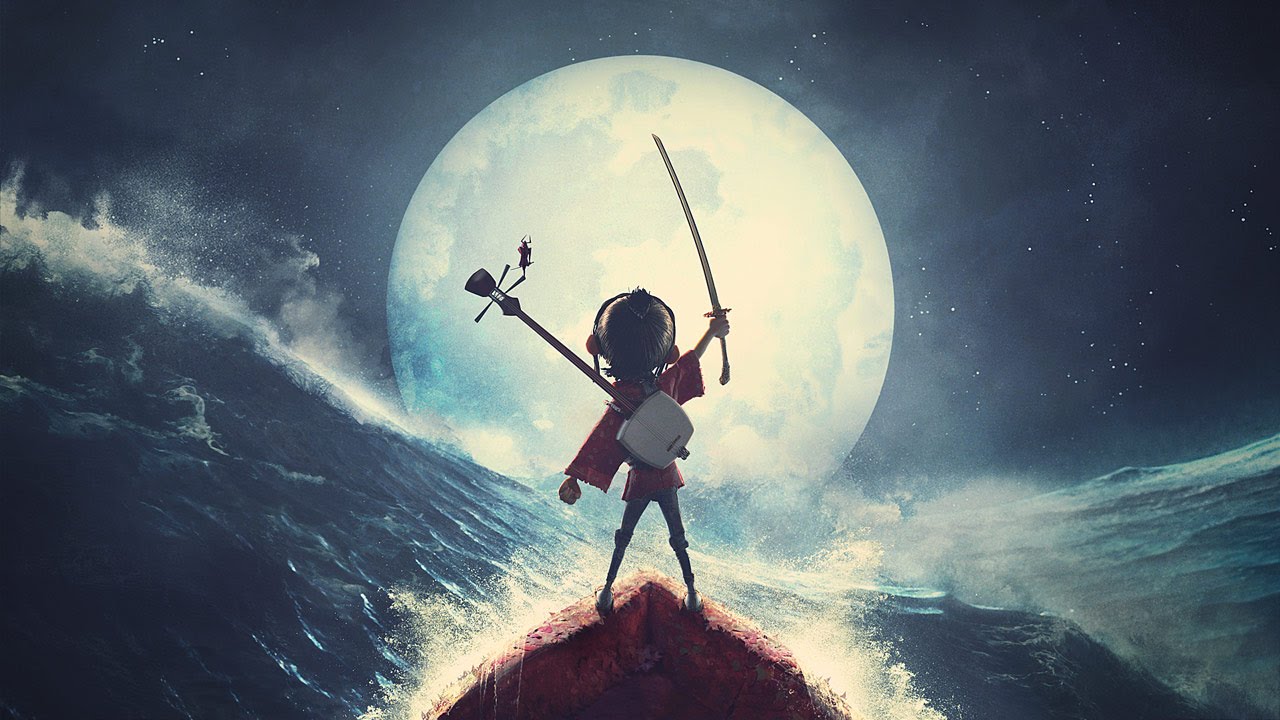
Kubo and the Two Strings begins with a thrilling, immaculately animated prologue, a tale of legendary heroism that sets a precise tone for the storytelling-obsessed film to follow. Once, a woman steered her boat through a troubled ocean, struggling to protect her newborn child at all costs. With only her magic and her shamisen (a Japanese stringed instrument), she manages to find her way to shore, cutting through the roiling waters like a certain prophet before her. But in Kubo’s world, magic and divinity alike are more complex than they seem. And survival isn’t necessarily a happy ending. Not when your child has lost one of his eyes to the forces of evil, at such a young age.

Laika, the visionary hybrid animators behind Coraline, Paranorman, and The Boxtrolls, have managed to craft a film that expands on the virtues of their predecessors, while also dipping a toe or two into more familiar, accessibly riveting territory. The film manages to capture the latter film’s gentle, innovative whimsy, Coraline’s kid-friendly perspectives on danger and consequence, and the emotional resonance that made Paranorman a treat. And it’s all in service of a story that generates consistent laughs and excitement while also exploring deeper questions about the value of living in a world fueled by greed, tyranny, and fear. Like the studio’s previous films, Kubo dares to dream that entertainment aimed at a younger audience can hold the depth and intelligence of any other substantial piece of filmmaking.

And if the film feels just a little more traditional than the boundary-pushing, family-friendly genre filmmaking Laika has explored in the past, Kubo is still rife with riches for viewers of any age. The titular hero (Art Parkinson, in a voice performance mercifully free of treacle) is restless but loyal, going into a nearby village in the daytime to deliver riveting performances of legends his mother passed down to him, and tending to her after the sun goes down. She’s catatonic much of the time, and even when enlivened, she struggles to retain the stories she so desperately wants to share with her son. Integral to Kubo from its early scenes is the power of storytelling as an innately human concept; through stories, we empower the young, articulate the tragedies of the world, and even uphold the spirits of those who have already left us. This includes Kubo’s father, a great warrior who died some years ago attempting to protect his family.

Kubo has some of the same magic in him as his mother does, and he uses it to rivet the villagers with retellings of his father’s war exploits and other stories, using ornately conjured origami creatures that he builds with magic. (The film’s use of formed and collapsed sheets of paper throughout is stunning by itself, to say nothing of the ways in which it uses this visual device.) The tale usually begins the same: “If you must blink, do it now.” It’s the way in which Mark Haimes and Chris Butler’s screenplay opens the film, and it’s as solid a testament as any to the value of keeping your eyes peeled throughout Kubo and the Two Strings.

The film is a visual feast from that tense opening to its sublime, heartfelt, golden-lit final shot, and in virtually every frame in between. Kubo’s yen for showmanship is one shared by director Travis Knight and the Laika team, but to its credit, Kubo roots its many breathtaking visuals in a simple but almost always effective story of love and adventure. When Kubo stays out past dark by accident one day, having attempted to communicate with his dead father during a local ritual paying tribute to the spirits of the dead, he draws the attention of his mother’s sisters (Rooney Mara, voicing both with an eerily icy lack of affect). They are witches in the truest sense, beings of powerful magic who want Kubo’s other eye at all costs, for unknown reasons. And when his mother purges the last of her magic to grant Kubo the chance to escape, he embarks on a quest to unify the disparate pieces of a legendary suit of armor which would allow him to defeat the sisters, and their nefarious father, the Moon King (Ralph Fiennes).

As tends to happen on quests, Kubo eventually finds himself running into a cast of wild characters, and if some of these moments make Kubo and the Two Strings come off a little more like a standard kid’s adventure story at times than its lyrical early moments initially suggest, they’re executed with a rare and striking kind of elegance. A wooden idol that Kubo held for years becomes Monkey (Charlize Theron), a sentient and dryly sarcastic ape tasked with helping Kubo find the three different pieces of armor. Along the way, they also happen upon Beetle (Matthew McConaughey, scattered and witty), a onetime compatriot of Kubo’s father who’s been cursed to forget all his memories of his life before, and also inhabit the multi-limbed body of a giant beetle, but with a human face.

While this review may already have touched on the many visual splendors the film offers, their power cannot be overemphasized. From the dusky fuschias and burning reds of Kubo’s campfire stories, to the blistering expanses of snowy white tundra, to the navy blues and blacks of a dilapidated fortress, Kubo and the Two Strings makes effective use of every imaginable color on the spectrum, and then some. A nightmarish battle involving a gigantic skeleton with a head full of swords is backed by vibrant notes of emerald green that make the skeleton’s hideous form protrude from the image. An underwater “garden of eyes” is full of hideously bulbous creations, black stalks topped by hideous oculi with a nauseous yellow where the whites might normally be. There isn’t a single sequence inKubo that fails to leave some sort of impression with its vivid imagery, and Laika’s trademark fusion of CGI and stop-motion animation gives the film’s many action scenes a tactile, physical quality that leaves the film several cuts above the vast majority of its peers.

Where so many modern animated films use their inflated budgets to pop the eyes and cover for a general lack of cohesive storytelling, Kubo understands the value of simplicity. Now, the film does have a tendency to overstate itself, particularly in its later minutes; its story is so classical in its notions of heroism and an open heart that the film’s eventual shift from a subtler, more understated kind of storytelling to that of a traditional hero’s journey feels extraneous after a point. And yet, a simple story told well can still be effective if the emotional resonance underneath it comes through. In Kubo, it absolutely does, thanks to the uniformly excellent voice performances. Theron is a particular standout, her Monkey transcending the kiddie-movie trappings of the character to offer an effective, wrenching mixture of deadpan humor and tentative warmth. (The animation deserves equal acknowledgment, Monkey’s features turning wistful or enraged or sad with impeccable accuracy and authenticity.)
Image result for kubo and the two strings
If Kubo does eventually hammer home its moral lessons, they come at the end of a film that speaks truth to the inevitability of letting go, and the power of gratitude for the riches that life does allow from time to time. When we age, and prepare to leave the world, what we leave behind is our truest legacy, and in a cultural period fraught with a general sense of exhausted nihilism, here is a film that believes in humankind’s capability to learn from its prior sins, to be better than it once was. To remember the tragedies of its past, so that they are never repeated. The film’s closing moments reject the cloying ease of the “happy ending” in favor of something more philosophical, honest, and emotionally rich, and it’s a superior piece of storytelling for it. In its way, Kubo and the Two Strings is at once a family film for any time, and one very specifically for this one. Sometimes, it’s easy to forget the story, because it hurts to remember or because we just choose to forget. In stories, we find eternal life.
Image result for kubo and the two strings

Friday, 26 February 2016

Anomalisa - Movie Review


There's everything else happening in America cinema, and then there's whatever Charlie Kaufman is up to.

Ever since 1999's "Being John Malkovich," he has been on a short list of American screenwriters whose work is so original that he must be thought of as an auteur, even though film is supposedly a director's medium. Formidable filmmakers have adapted his scripts, including Spike Jonze("Malkovich" and "Adaptation") and Michel Gondry ("Eternal Sunshine of the Spotless Mind" and "Human Nature"), but however assured the results, they were still unmistakably Charlie Kaufman movies, speaking their own alternately down-to-earth and elevated language.

Kaufman's mix of mordant humor, broad slapstick, self-aware storytelling devices, and images and language drawn from psychoanalysis, poetry and dreams coalesced even more strongly in his directorial debut, "Synecdoche, New York," about a playwright spending years (or a lifetime?) rehearsing and rewriting a massive production that was about his life but seemed indistinguishable from it. The undercurrents of wonder and despair ran deeper there than in any other Kaufman story, even "Eternal Sunshine."

They course throughout "Anomalisa" as well. The film could be described as a midlife crisis drama with puppets, about a depressed corporate efficiency expert (voiced by David Thewlis) who hears every voice, male or female, as the same voice (Tom Noonan's), and who becomes infatuated with a shy young woman (Jennifer Jason Leigh) who is attending his seminar in Cincinnati, Ohio. "Anomalisa" is based on an "audio play" by Kaufman. It was originally presented as part of a series of such plays, in collaboration with Joel and Ethan Coen and composer Carter Burwell, who has scored movies by both directors, including this one. The actors performed their lines while Burwell conducted a live score and sound effects artists provided background noises. Kaufman co-directed this film version with stop-motion animator Duke Johnson, whose work includes the "Community" episode "Abed's Uncontrollable Christmas." It puts a "visual track" to Kaufman's audio play. The puppets are physically recognizable as "puppets," down to the segmented lines of their "face plates." But they move so realistically and speak so naturalistically (even when they're skipping across the tops of desks, as in the image at the top of this page) that there are times when you may forget that they're not people.

The puppet characters in most other films are more sprightly. They exist mainly to amuse. The characters in "Anomalisa" unsettle. Their plight makes you think about 21st century loneliness, despair and alienation— subjects that would be unpalatable if Kaufman didn't write his characters so compassionately and with such dry humor. Kaufman and Johnson shoot the characters in a carefully considered way, not cutting much, just sort of letting them sit there, and be. There are a few stealthy "long takes" in this film that would be much praised if they appeared in a live-action feature—sequences where the filmmakers simply follow characters as they traverse levels of the hotel, or have sex in a slab-like bed.

It might sound strange to say, but this puppet movie gives you a more accurate sense of what it's like to spend a few days in a nice hotel in a city of bad memories than most live-action films ever do—not that that's necessarily the kind of description that will make people want to rush out and see "Anomalisa." Like so many Kaufman characters, the ones in this movie are struggling, stumbling even, towards what might be a mirage of happiness, while battling both their own social conditioning and pathologies and the bland indifference of the world around them—a world that includes billions of other people who all think they are the stars of their own life-movies, and at times seem deeply frustrated by the fact that they haven't experienced one of those transformative moments that tell moviegoers, "Everything is going to be fine for this character now, don't worry."

Thewlis' Michael Stone is clearly unhappy with his work, his marriage, even his child. He seems disconnected from himself and the world. Not much happens to him in the plot sense. His plane touches down in Cincinnati. He settles into the hotel and orders room service while pacing and smoking a cigarette. He impulsively invites an old flame out for a drink hoping to get lucky, oblivious to the fact that he hurt her so terribly that it's painful for her to be in the same room with him.

Then he becomes smitten with a guest at the conference, a young woman who wears her hair to one side to hide a scar on her face. Her name is Lisa (Leigh), and she's the only character in the film who has her own voice (everyone else is voiced by Tom Noonan, remember). It's love at first sight—or Michael thinks it is. He seems to view Lisa as a redemptive figure, somebody who will pull him out of his existential malaise. But by that point we've spent enough time with Michael to know that he's not the best judge of what he needs. In fact his judgment is consistently terrible, and in typically Kaufman-esque fashion, we move from feeling for Michael and rooting for him to be happy to wondering if he's got some sort of debilitating emotional or mental condition (beyond the titular disorder). Then we progress into thinking about ourselves as much as Michael, contemplating our own fears, weaknesses, blind spots, and repetitive behaviors in relation to a world that barely seems to notice us.

For all its visual audacity and honest feeling, "Anomalisa" is a modest, even slight work, aesthetically sealed off from the same reality it engages. It ends a bit abruptly, just when it seemed to be ramping up towards a more definitive statement of some kind, and the general outlines of Michael's story aren't new. (Middle-Aged, Upper Middle-Class Male Grappling with Despair is pretty much a genre by this point.) But there's so much beauty and sadness in it, and so many exquisitely conceived scenes (including an impromptu musical performance that ranks with Kaufman's greatest moments), that it would be miserly to underrate it. Whether you leave the film ecstatically impressed, indifferent or disappointed, you will know you've seen something unique. Too many movies speak in a boringly typical storytelling voice. This one speaks in a voice as singular as Lisa's.